LendPoint
Loan Management Glossary: 36 Lending Terms Every Kenyan Lender Should Know

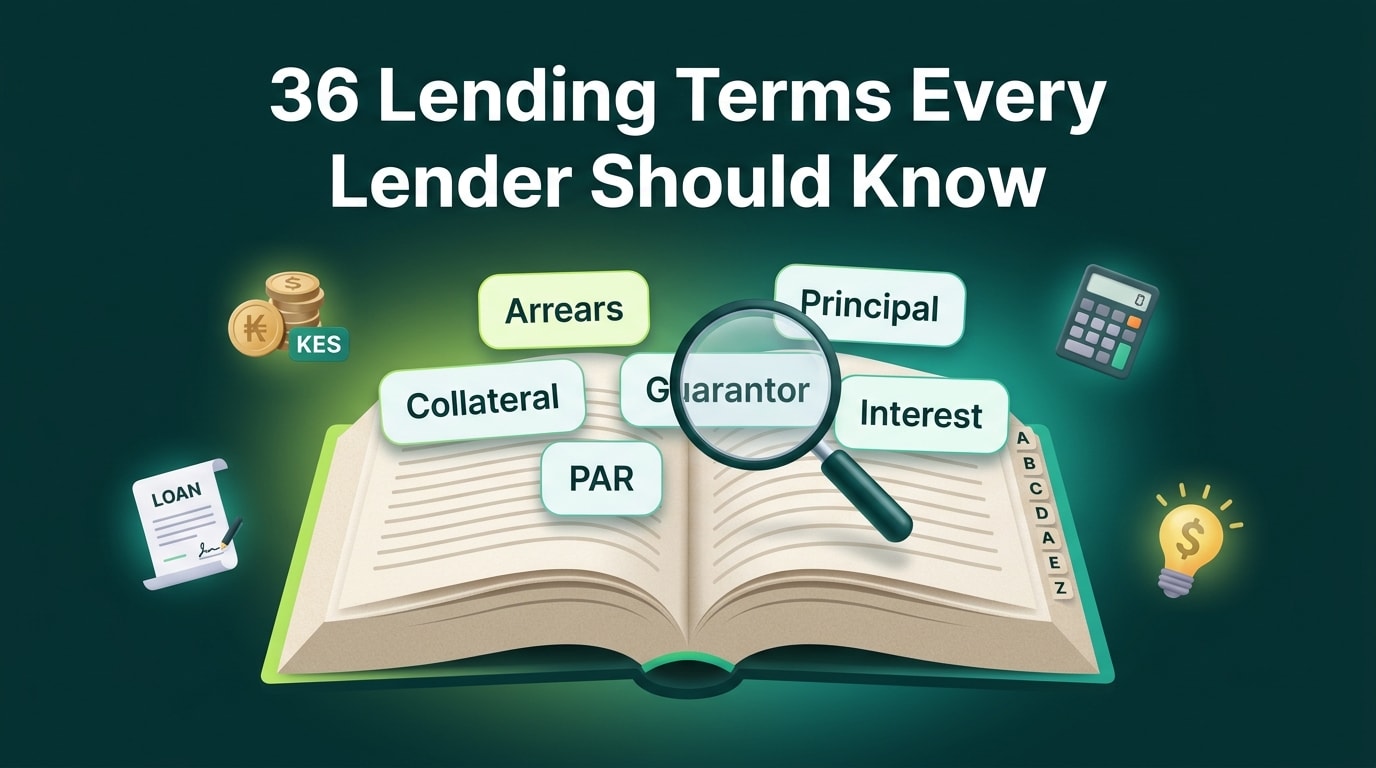
Lending in Kenya has its own vocabulary: some of it from banking, some from M-Pesa, and a growing amount from CBK's 2026 rules for non-deposit-taking lenders. This glossary explains the terms SACCO officials, MFI managers and lenders meet most often, in plain English, with links to our deeper guides.
Loan products and interest
Loan management system (LMS)
Software that runs the loan lifecycle: onboarding borrowers, loan products, applications and approvals, disbursement, repayment schedules, collections and reporting. In Kenya it should also disburse and collect through M-Pesa. See the complete guide to the loan management system in Kenya.
Loan origination
The front end of lending: application, KYC, credit checks, appraisal and approval, up to the point the loan is booked.
Principal
The amount lent, excluding interest and fees.
Flat rate interest
Interest calculated on the original principal for the whole term, however much has been repaid. On a 12-month loan, 2% flat a month costs roughly double 2% on a reducing balance.
Reducing balance interest
Interest charged only on the principal still owed, so it falls as the loan is repaid. See flat rate vs reducing balance.
Amortised loan (equal installments)
A reducing balance loan repaid in equal installments. Early payments are mostly interest, and later ones mostly principal.
Bullet loan
A loan repaid in one lump sum at the end of the term, common for short payday-style loans.
APR (annual percentage rate)
The yearly cost of a loan, including interest and upfront fees, used to compare loans fairly. Credit-only lenders must disclose it before lending.
Total cost of credit
Everything a borrower pays on top of the principal: interest plus all fees and charges.
Processing fee
An upfront charge for setting up a loan, either deducted from the amount disbursed or added to repayments.
Check-off loan
A loan repaid by salary deduction: the employer deducts each installment and remits it to the lender. Total deductions are capped at two-thirds of wages. See check-off loans in Kenya.
Guarantor
A person who agrees to repay if the borrower doesn't. It's common in SACCO lending.
Collateral
An asset pledged as security, such as a vehicle logbook or a title deed, which the lender can realise through a lawful process if the borrower defaults.
Rollover
Closing an existing loan and replacing it with a new one, usually to give an overdue borrower more time. It should be recorded as a linked loan so arrears aren't hidden.
M-Pesa and payments
Paybill
A Safaricom M-Pesa business number that customers pay into, using an account number to identify the payment.
B2C (business to customer)
The M-Pesa API a lender uses to send money to a customer's phone, for example to disburse a loan.
C2B (customer to business)
The M-Pesa API that notifies a lender's system when a customer pays into its Paybill, so the repayment can be matched to the right loan automatically.
STK push
A payment prompt sent to the customer's phone with the amount already filled in, which they approve with their M-Pesa PIN.
Daraja
Safaricom's developer platform for M-Pesa APIs, including B2C, C2B and STK push. See how to automate M-Pesa loan repayments.
Reconciliation
Matching every payment received to the loan it belongs to. Done by hand from M-Pesa statements, it's slow and hides arrears. Done automatically, it happens as each payment arrives.
Arrears and portfolio quality
Arrears
Installments that are past due and unpaid. See loan arrears management.
Grace period
A short window after the due date before penalties apply.
PAR (portfolio at risk)
The share of the loan book with overdue installments. PAR1 counts any overdue amount, and PAR30 counts loans more than 30 days late.
Non-performing loan (NPL)
For credit-only lenders under CBK's 2026 rules: a loan of 30 days or less becomes non-performing once principal or interest is still unpaid 30 days after it falls due, and a longer loan after 90 days, unless the agreement says otherwise. See how to cut NPLs.
In duplum rule
A cap on what a lender can recover on a non-performing loan: the principal owing when it became non-performing, plus interest no greater than that principal, plus reasonable recovery costs. See the in duplum rule in Kenya.
Provisioning
Setting money aside against expected loan losses. SACCOs regulated by SASRA must provision 1%, 5%, 25%, 50% and 100% for performing, watch, substandard, doubtful and loss loans. See SASRA reporting requirements.
Write-off
Removing a loan judged uncollectible from the active loan book.
Collection rate
The amount collected divided by the amount due in a period, the headline measure of collections performance. See loan collection software.
Regulation and compliance
CBK (Central Bank of Kenya)
The regulator for banks, microfinance banks and, since 2026, all non-deposit-taking lenders.
Non-deposit-taking credit provider (NDTCP)
A lender that lends its own money and takes no deposits: digital lenders, micro lenders, logbook and asset lenders, and BNPL providers. These lenders must be licensed or registered by CBK under Legal Notice 191 of 2026.
Digital credit provider (DCP)
The older term for licensed digital lenders under the 2022 regulations. These lenders are now treated as non-deposit-taking credit providers. See how to get a CBK lending licence.
Legal Notice 191
The Central Bank of Kenya (Non-Deposit Taking Credit Providers) Regulations, 2026, gazetted on 29 September 2026. They cover licensing, pricing, disclosure, collections, CRB reporting, data and AI decisions. See debt collection rules for lenders.
SASRA
The Sacco Societies Regulatory Authority, which licenses and supervises deposit-taking SACCOs.
CRB (credit reference bureau)
A licensed bureau that holds borrowers' credit histories. Lenders share data with bureaus and check them before lending. See CRB reporting for lenders.
KYC (know your customer)
Verifying a borrower's identity and details before lending, such as their ID, KRA PIN and phone number.
ODPC
The Office of the Data Protection Commissioner. Lenders must register with it as data controllers whatever their size. See data protection for lenders.
Ready to see these in a working system? Compare what loan management software costs in Kenya, or start a 7-day free trial of LendPoint.
Frequently asked questions
What is a loan management system?
Software that runs the loan lifecycle, from borrower onboarding and approvals to disbursement, repayment schedules, collections and reporting. In Kenya it should also handle M-Pesa disbursement and repayment matching.
What is the difference between flat rate and reducing balance?
Flat rate charges interest on the original amount for the whole term. Reducing balance charges interest only on what is still owed, so it costs less at the same headline rate.
What does PAR30 mean?
Portfolio at risk over 30 days: the share of the outstanding loan book belonging to loans with an installment more than 30 days overdue.
What is a non-deposit-taking credit provider in Kenya?
A lender that lends its own money and takes no deposits, regulated by CBK under the 2026 Non-Deposit Taking Credit Providers Regulations (Legal Notice 191).
What is STK push?
An M-Pesa payment prompt sent to a customer's phone with the amount filled in, which the customer approves with their PIN.