Loan Collection Software in Kenya: How to Collect More, Within CBK's Rules

Loan collection software automates the work of getting repayments in: reminding borrowers before they're late, making it easy to pay, matching payments to the right loan, flagging arrears early, and giving collectors a clear, logged process when someone falls behind. For Kenyan lenders, it now has a second job: keeping collections within CBK's 2026 rules.
This guide explains what collection software should do in Kenya, the numbers to track, and how to choose a system. It's written for MFIs, SACCOs, digital lenders and growing micro lenders.
Why collections break down without software
- Payments are reconciled by hand. Someone reads the M-Pesa statement and updates a spreadsheet, so a missed installment is only noticed days or weeks later.
- Reminders depend on memory. Officers send SMS when they have time, so borrowers who simply forgot are never reminded.
- Borrowers who already paid get chased. When balances are wrong, collectors call people who already paid, which damages trust and invites complaints.
- Penalties are applied inconsistently. Different staff charge or waive differently, and some charges were never in the contract. Under the 2026 rules, you can't recover undisclosed charges.
- There's no record. When a borrower complains about harassment, you can't show what was actually sent or said.
What loan collection software should do
1. Prevent arrears before they start
Send automatic SMS reminders before and on each due date, and confirm every payment received. Most late payments are forgotten payments, and reminders are the cheapest collection tool you have.
2. Make paying effortless
In Kenya, that means M-Pesa. Look for STK push, which sends a payment prompt for the exact installment so the borrower just enters their PIN. Look also for automatic matching of Paybill (C2B) payments to the right loan, and USSD repayment for borrowers on feature phones. See how M-Pesa repayment automation works.
3. Flag arrears on day one
Because every payment is matched as it arrives, an unpaid installment should show as overdue the day after its due date, sorted by branch and officer, so follow-up starts while the amount is small.
4. Apply penalties consistently, and only as disclosed
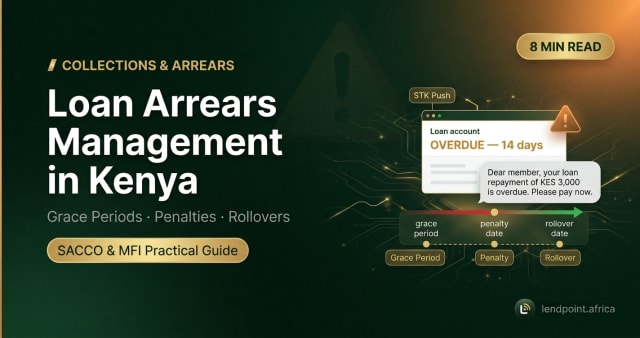
Configure your grace period and penalty policy once and let the system apply it to every borrower the same way. Charges must match the loan agreement, because CBK can order refunds of anything undisclosed. Our guide to grace periods, penalties and rollovers covers policy design.
5. Support compliant follow-up
The 2026 regulations ban:
- contacting a borrower's phone contacts,
- shaming, threats and harassment,
- calls outside working hours.
They also cap the interest you can recover on a non-performing loan and set notice rules for CRB listing. Good software helps you follow these rules: it never touches phone contacts, keeps messages to the borrower and guarantor, records the date each loan became non-performing, and logs every action. Read the full debt collection rules for lenders in Kenya.
6. Restructure and roll over with a record
When a borrower genuinely can't pay, a recorded restructure or rollover is better than an informal promise. The original loan should close and the new one should link to it, so your portfolio at risk reflects reality.
7. Measure collectors, not just loans
Set collection targets per officer and track them, so you can see which branch or officer is building arrears before month end.
The collection numbers to track every week
| Metric | What it tells you |
|---|---|
| Collection rate | Amount collected ÷ amount due this period. Your headline health number. |
| PAR1 | Share of the portfolio with any installment overdue. The earliest warning. |
| PAR30 | Share of the portfolio more than 30 days overdue. The standard microfinance measure. |
| Non-performing loans | Loans past the regulatory line: 30 days unpaid for loans of 30 days or less, otherwise 90 days. |
| Cure rate | Share of overdue loans brought back to current. Shows whether follow-up works. |
| Collections by officer and branch | Where arrears are building, and who needs support. |
For how these numbers fit together, see how Kenyan MFIs cut NPLs.
Standalone collection tool or loan management system?
Some lenders buy a separate collections or dialer tool. For most Kenyan MFIs, SACCOs and micro lenders, collections work best inside the loan management system. The reminders, penalties, M-Pesa matching and arrears all depend on the same loan data, and keeping them in one system avoids the mismatched balances that cause wrongful chasing. A separate tool makes sense mainly for high-volume call-centre collections.
Checklist for choosing loan collection software
- Does it send automatic SMS reminders before and on due dates?
- Does it support M-Pesa STK push and automatic Paybill matching?
- Are overdue installments flagged the day after they fall due?
- Can you configure grace periods and penalties once, and have them applied consistently?
- Does it record when each loan became non-performing?
- Are restructures and rollovers recorded as linked loans?
- Can you set and track collection targets per officer and branch?
- Is every reminder, penalty and payment logged in an audit trail?
- Does it avoid any access to borrowers' phone contacts?
- Is pricing published in KES, with a free trial?
How Lendpoint handles collections
Lendpoint builds collections into the loan management system:
- SMS reminders before and on due dates, plus payment confirmations.
- M-Pesa STK push, automatic Paybill matching and USSD repayment.
- Overdue flags from day one.
- Penalties applied by your configured policy.
- Rollovers recorded as linked loans.
- Collection targets per officer.
- A full audit trail.
Lendpoint doesn't access borrowers' phone contacts. Pricing starts at KES 5,000 a month, with a 7-day free trial. See Lendpoint for MFIs and micro lenders.
Frequently asked questions
What is loan collection software?
Loan collection software automates getting repayments in. It sends reminders, collects payments through M-Pesa, matches each payment to the right loan, flags arrears early, applies penalties consistently and logs every collection action.
What is the best loan collection software in Kenya?
For most Kenyan lenders, the best option is a loan management system with collections built in. Look for native M-Pesa STK push and Paybill matching, automatic SMS reminders, day-one arrears flags, consistent penalties, officer targets and a full audit trail.
Is it legal to contact a borrower's phone contacts in Kenya?
No. Under CBK's 2026 regulations for non-deposit-taking lenders, lenders and their agents may not access a borrower's contacts or message them about a late or missed payment.
How can I improve my loan collection rate?
Remind borrowers before the due date, make paying a one-step M-Pesa prompt, follow up the day an installment is missed, apply penalties consistently, and track collection rate and PAR weekly by officer and branch.
Should collections be in a separate system from loan management?
Usually not. Reminders, penalties and arrears all depend on accurate loan and payment data, so keeping collections inside the loan management system avoids mismatched balances and wrongful chasing.