Loan Arrears Management in Kenya: Grace Periods, Penalties and Rollovers (With KES Examples)

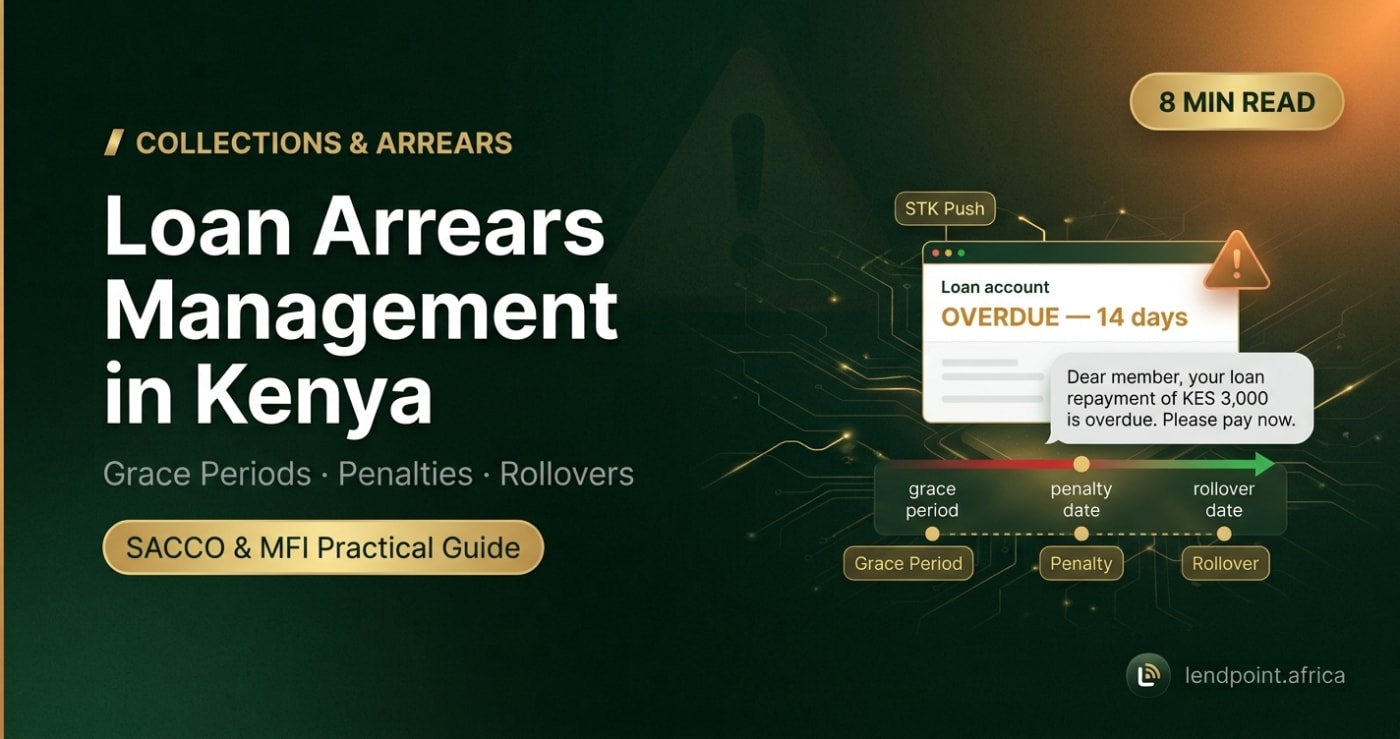
Short answer: good arrears management in Kenya comes down to four rules decided in advance: remind borrowers before the due date, give a short and fixed grace period, apply one clear, predictable consequence when the grace period ends (a penalty, a restructure or a review), and record every step. Lenders who set these rules once and let the system apply them consistently collect more and argue less than lenders who decide case by case at month end.
Every SACCO and microfinance institution has loans in arrears. What separates a healthy portfolio from a struggling one is not whether borrowers fall behind, but how quickly and fairly the lender responds. This guide covers the arrears timeline, how to set grace periods and penalties, when a rollover makes sense, and the numbers your board should watch, with worked examples in Kenya shillings.
What "in arrears" actually means
A loan is in arrears when a scheduled instalment has passed its due date without being paid in full. Note the word instalment: a borrower who has repaid 80% of a loan can still be in arrears if this month's instalment is late. That is why arrears should be tracked per instalment, not just per loan balance.
Lenders usually group overdue loans by how late they are:
| Days overdue | Typical status | Recommended action |
|---|---|---|
| 1 – grace period | Late, within grace | Automatic SMS reminder, no charge |
| Grace period – 30 | In arrears | Penalty or review applied; phone call from loan officer |
| 31 – 90 | Serious arrears | Guarantors notified; restructure considered; field visit |
| 90+ | Non-performing | Formal recovery process; provisioning; board reporting |
Step 1: Remind before the due date, not after
The cheapest collection is the one you never have to make. A reminder SMS sent two or three days before an instalment is due, and again on the day, catches the large group of borrowers who intend to pay but simply forget. It costs a few shillings per message and prevents most first-time arrears.
Make the reminder useful: include the amount, the due date, and exactly how to pay (for example your Paybill and account number). If you have not automated your M-Pesa collections yet, read our guide on how to automate M-Pesa loan repayments, because reminders work far better when paying takes ten seconds.
Step 2: Set a short, fixed grace period
A grace period is the number of days after the due date before any consequence applies. It absorbs genuine delays: salary landing a day late, M-Pesa downtime, a weekend.
- Three days is a common, sensible default for monthly loans.
- Zero days can suit very short-term digital loans where the whole product is priced around speed.
- Longer than a week usually just trains borrowers to pay late.
Whatever you choose, apply it to every borrower on the same product. A grace period that depends on who the borrower knows in the office is the fastest way to lose trust and invite disputes.
Step 3: Choose your overdue strategy
When the grace period ends, something should happen automatically. There are three common approaches, and many institutions use a mix.
Option A: Automatic penalty
A late-payment charge is added to the overdue instalment. It is simple, predictable and easy to explain in the loan agreement. It works best for salaried or business borrowers who can pay and just need a firm nudge.
Option B: Flag for rollover or restructure, no penalty
Instead of penalising, the loan is flagged so staff can restructure it: the outstanding balance is moved into a new loan with a new schedule, and the original loan is closed. This suits borrowers hit by a genuine shock (a failed harvest, a hospital bill) where a penalty would only deepen the problem.
Option C: Per-member rules with manual review
Each member can carry their own rule. Where a member has none, the loan is flagged for a staff member to decide. This works well for SACCOs that know their members personally, but it needs someone to actually clear the review list every day.
How to set penalties fairly: a worked example
How you charge the penalty matters as much as whether you charge it. Consider a borrower with a monthly instalment of KES 5,000 who pays 60 days late, and compare three common structures:
| Penalty structure | Calculation | Penalty after 60 days |
|---|---|---|
| One-time 5% of the overdue instalment | 5,000 × 5% | KES 250 |
| 5% per month on the overdue instalment | 5,000 × 5% × 2 months | KES 500 |
| 1% per day on the overdue instalment | 5,000 × 1% × 60 days | KES 3,000 |
The daily structure adds KES 3,000, which is 60% of the instalment, in just two months. It looks profitable on paper, but in practice it produces balances the borrower can never clear, more write-offs, complaints, and reputational damage. A one-time, clearly disclosed penalty per overdue instalment is easier to defend and more likely to be paid.
Three rules keep penalties fair and defensible:
- Disclose it upfront. The penalty rate, when it applies and the grace period belong in the loan agreement and product terms.
- Charge each instalment once. Never apply the same penalty twice to the same late instalment.
- Cap the total. Kenyan banks are bound by the in duplum rule in the Banking Act, which limits interest and charges on a non-performing loan to the outstanding principal. Even if your licence falls under a different law, it is good practice to set a similar cap. Confirm the rules for your institution with your advocate or regulator.
Step 4: Allow waivers, and log them
There will always be cases where a penalty should not stand: a payment that was made on time but credited late, a bereavement, a documented error. Allow authorised staff to waive penalties on a specific loan, but make sure every waiver is recorded with who approved it and when. Unlogged waivers are one of the most common sources of internal fraud in lending institutions.
When a rollover helps, and when it hides bad debt
A rollover (or restructure) replaces an overdue loan with a new one, usually over a longer period with a lower instalment. Used well, it keeps a good borrower in good standing through a temporary shock. Used badly, it makes arrears disappear from reports without a single shilling being collected.
Warning signs that rollovers are hiding problems:
- The same borrowers are rolled over more than once a year.
- Rollovers spike just before month-end or board meetings.
- Rolled-over loans are not reported separately from new lending.
A healthy system keeps a permanent link between the original loan and the new one, so anyone reviewing the portfolio can see exactly which loans have been restructured and how many times.
The numbers your board should watch
Portfolio at Risk (PAR) is the standard measure of arrears in microfinance. PAR30 is the outstanding balance of all loans with an instalment more than 30 days overdue, divided by the total outstanding portfolio.
Example: a SACCO has KES 10,000,000 in outstanding loans. Loans with an instalment more than 30 days late have outstanding balances totalling KES 850,000. PAR30 = 850,000 ÷ 10,000,000 = 8.5%.
Also track:
- Collection rate: amount collected this month ÷ amount that fell due this month.
- Rollover volume: number and value of loans restructured, reported separately.
- Penalties charged vs penalties collected: a large gap means penalties are adding to balances rather than changing behaviour.
Note the "outstanding balance" in PAR: it includes loans where only one instalment is late. That is deliberate. A loan with one missed payment is far more likely to miss the next.
How Lendpoint automates arrears management
In Lendpoint you set the rules once in your organisation settings, and they run every day without anyone touching a spreadsheet:
- Repayment reminders go out by SMS and email a set number of days before each due date.
- A configurable grace period (three days by default, or switched off entirely) applies before any action.
- Your overdue strategy (automatic penalty, flag for rollover, or per-member rules with manual review) is applied to every overdue instalment consistently.
- Penalties are charged once per overdue instalment, the borrower is notified, and staff can waive penalties on individual loans.
- Rollovers close the original loan and create a new one that stays linked to it, so restructured loans are never hidden.
- Every action (penalty, waiver, review flag, rollover) is written to the loan's audit log.
For the full picture of how arrears fit into the loan lifecycle, see our complete guide to loan management systems in Kenya.
Frequently asked questions
How many days is a loan in arrears before it becomes non-performing?
In common practice, a loan is treated as non-performing once a payment is more than 90 days overdue. Check the specific classification rules that apply to your institution.
Should a SACCO charge penalties on late loan repayments?
Most do, as long as the penalty is approved under the SACCO's by-laws or loan policy, disclosed in the loan agreement, and applied consistently to every member.
What is a reasonable grace period for a monthly loan?
Around three days is common. It covers normal delays without encouraging late payment.
Is a loan rollover the same as a write-off?
No. A rollover moves the outstanding balance into a new loan that the borrower still repays. A write-off removes the balance from the books as unrecoverable.
Can penalties be reversed?
Yes. Authorised staff should be able to waive a penalty, and every waiver should be recorded with who approved it and why.
Want arrears handled the same way every day, for every borrower? Start a free trial of Lendpoint or book a demo and we'll set up your grace period and overdue rules with you.