Loan Management System in Kenya — Complete Guide for SACCOs & MFIs 2026

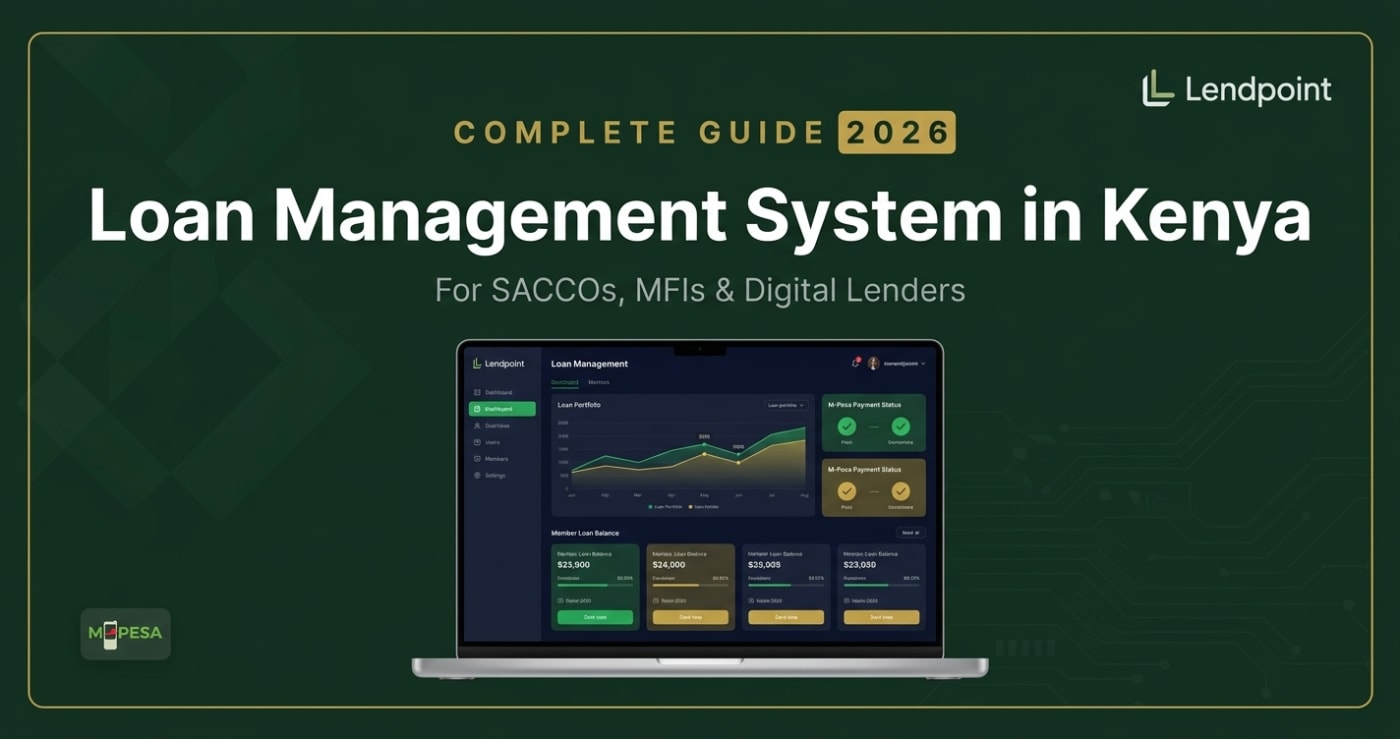
A loan management system in Kenya is software that automates the whole lending lifecycle for SACCOs, microfinance institutions (MFIs) and digital lenders. It starts when a borrower applies and ends with the final M-Pesa repayment. It replaces paper forms, Excel ledgers and WhatsApp approvals with one system, and it keeps a complete record of every decision and every shilling.
This guide covers how these systems work and how they differ from core banking software and spreadsheets. It also covers which Kenyan regulations affect your choice, what a system costs in KES, and how to choose and implement one. It is written for SACCO managers, MFI operations leads and digital lending founders evaluating software in 2026.
What is a loan management system in Kenya?
Every lender runs the same basic cycle: assess the borrower, decide, disburse, collect and report. A loan management system (LMS) digitises that cycle. What makes a Kenyan LMS different is the environment it runs in:
- M-Pesa is the payment rail. Most loans are disbursed to and repaid from mobile money, so the system must talk to Safaricom's Daraja API rather than rely on manual reconciliation.
- Many borrowers use feature phones. USSD access matters as much as an app.
- Several regulators are involved. SASRA, the Central Bank of Kenya, the Data Protection Commissioner and the credit reference bureaus each shape what records you must keep.
- Loan products are short and frequent. Weekly and bi-weekly installments are common in microfinance, and many imported systems assume monthly loans.
How a loan management system works, step by step
- Onboarding. The borrower is registered with KYC details, and guarantors and collateral are recorded where your policy requires them.
- Application. The borrower applies at a branch, through a web portal or app, or by dialling a USSD code.
- Eligibility. The system checks the borrower's credit score and loan limit against the product's rules, such as the minimum score, the amount range and whether other loans are still open.
- Approval. The application moves through your approval workflow. Every decision is logged with who made it and when.
- Schedule. On approval, interest (flat or reducing balance), fees and the full repayment schedule are calculated and fixed.
- Disbursement. Funds are sent to the borrower's M-Pesa through the B2C API, and the borrower gets an SMS with the amount, total repayment and due date.
- Reminders. SMS reminders go out before and on each due date.
- Collection. Repayments through Paybill (C2B) or STK push are matched to the loan automatically and posted to the ledger. See how M-Pesa repayment automation works.
- Arrears. Missed installments are flagged on day one, and penalties follow your configured policy. Rollovers are recorded as linked loans. See our guide to arrears, penalties and grace periods.
- Reporting. Dashboards show disbursements, collections and arrears as they happen, by branch and by officer.
Loan management system vs core banking vs Excel
Lenders often ask whether they need a loan management system or a full core banking system. They solve different problems:
| Excel and paper | Loan management system | Core banking system | |
|---|---|---|---|
| Main job | Record keeping | Run the full lending lifecycle | Run deposits, accounts and loans for a bank or deposit-taker |
| M-Pesa disbursement and matching | Manual | Automatic | Usually through a separate integration |
| Audit trail | None or partial | Every loan action | Every transaction |
| Typical cost in Kenya | Staff time | From a few thousand KES per month (SaaS) | Millions of KES in licence and implementation |
| Time to go live | Immediate | Days to weeks | Months |
| Best for | Very small, informal lenders | Credit-focused SACCOs, MFIs and digital lenders | Banks, microfinance banks and large deposit-taking SACCOs |
If most of your risk and workload sits in lending rather than deposits, a loan management system is usually the faster and cheaper fix.
Key features every loan management system in Kenya must have
- Native M-Pesa integration: B2C disbursement, C2B Paybill repayment matching and STK push, posted straight to the ledger.
- Flexible loan products: weekly, bi-weekly and monthly installments, bullet loans, flat or reducing-balance interest, processing and legal fees, and early repayment discounts.
- Credit control: credit scores and loan limits per borrower, minimum scores per product, and guarantor and collateral records.
- USSD and self-service: borrowers can check limits, apply, repay and get statements from any phone.
- Automated collections: SMS reminders, day-one arrears flags, policy-driven penalties and recorded rollovers.
- Accounting: a general ledger behind every disbursement, repayment, fee and penalty, with exportable reports.
- Branches and roles: per-branch access and approvals, with consolidated views for head office.
- Audit trail and data isolation: every action logged and your data kept separate from other customers'.
Kenyan regulation and your loan management system
No Kenyan regulator approves or certifies loan software. Regulators supervise lenders. But your system decides how easily you can show you are meeting your obligations.
| Regulator or law | Who it covers | What it means for your system |
|---|---|---|
| SASRA, under the Sacco Societies Act, 2008 | Deposit-taking SACCOs and specified non-withdrawable deposit-taking SACCOs | Accurate, auditable loan records and portfolio data for statutory returns and inspections |
| Commissioner for Co-operative Development | SACCOs outside SASRA's scope | Proper books for annual audits and members' meetings |
| Central Bank of Kenya, under the Microfinance Act, 2006 | Deposit-taking microfinance banks | Typically a full core banking system, with prudential reporting |
| CBK, under the CBK Act (as amended in 2024) and the Non-Deposit-Taking Credit Providers Regulations, 2026 | Every lender that lends its own money without taking deposits, digital or not (281 licensed digital lenders by September 2026) | CBK-approved pricing, full cost disclosure (including APR), fair collections, complaint handling, and explainable automated decisions |
| Data Protection Act, 2019 (ODPC) | Every lender handling borrowers' personal data | Registration as a data controller where required, access control, and secure, purpose-limited data handling |
| Credit reference bureau regulations | Banks, microfinance banks, SACCOs and licensed credit providers that share data | Clean repayment histories you can export and report |
This is a summary, not legal advice. Rules change, so confirm your obligations with your regulator and advisers.
Which institutions use loan management systems in Kenya?
SACCOs
SACCOs use an LMS to run the credit side: loan products, guarantors, approvals by the credit committee, M-Pesa disbursement, check-off or mobile repayments and arrears follow-up. If you also need savings, shares and dividends in the same system, check that the vendor covers them. Lendpoint focuses on lending, and full SACCO operations are coming in our sister product SaccoPoint. See Lendpoint for SACCOs.
Microfinance institutions
Credit-only MFIs handle high volumes of small, frequent loans across branches, so automated collections and branch-level control matter most. See our microfinance management system.
Digital credit providers
App and USSD lenders need instant decisions, instant M-Pesa disbursement and collections that run without staff. See digital lending software for Kenyan lenders.
Individual lenders and small credit businesses
Small lenders who have outgrown a notebook or spreadsheet get the same automation at a smaller scale. Often the biggest win is simply never reconciling M-Pesa by hand again.
How much does a loan management system cost in Kenya?
Pricing in Kenya usually follows one of two models:
- One-off licence. You buy the software, often with yearly support fees. There's a high upfront cost, and you depend on the vendor for updates.
- Subscription (SaaS). You pay monthly or yearly for a hosted system. There's a low upfront cost, and updates are included.
Whichever model you choose, budget for the extras vendors often leave out of the headline price:
- SMS: bulk SMS credit, plus a one-off fee for a branded Sender ID per mobile network.
- M-Pesa charges: Safaricom's transaction charges on disbursements and collections.
- Onboarding and migration: moving existing borrowers and active loans in.
- Training and support: check what is included after go-live.
Lendpoint publishes its prices. The Starter plan is KES 5,000 per month and the Professional plan, for multi-branch lenders, is KES 8,000 per month. Yearly billing saves about 17%, and a one-time KES 10,000 onboarding and migration fee applies. Compare plans.
How to choose a loan management system: 10 questions to ask
- Does it disburse and collect through M-Pesa natively, with automatic matching?
- Can it model your actual products, such as weekly installments, bullet loans, your fees and your interest method?
- Can borrowers without smartphones use it through USSD?
- Is every loan action recorded in an audit trail you can show an auditor?
- Does it support your branches, with access restricted per branch?
- Can you export clean data for regulatory returns and credit bureau reporting?
- Where is your data held, and is it isolated from other customers' data?
- Is the price published in KES, including SMS, onboarding and support?
- How long does migration take, and who does the work?
- Can you try it with your own products before you pay?
For a side-by-side view of vendors, see the best loan management systems in Kenya.
Implementing a loan management system: a typical timeline
| Stage | What happens | Typical time |
|---|---|---|
| Setup | Create the account, configure loan products, fees, penalty policy and staff roles | 1–3 days |
| Migration | Bulk-upload borrowers, load active loans and balances, and reconcile them to your records | Days to two weeks, depending on data quality |
| M-Pesa | Connect your Paybill through Safaricom Daraja and run test transactions | Depends on Safaricom approval of your API access |
| Training and go-live | Train staff, open borrower access, and run old and new processes side by side for a short period | About 1 week |
The step that most often delays go-live is messy historical data. Cleaning your borrower list and active-loan balances before migration saves the most time.
Why Kenyan lenders choose Lendpoint
Lendpoint is built in Kenya for how Kenyan lenders work. M-Pesa disbursement, Paybill matching and STK push are part of the core system, not add-ons. Borrowers get USSD, a branded portal and a mobile app. Loan products support weekly, bi-weekly and monthly installments and bullet loans, with flat or reducing-balance interest. Collections, penalties and rollovers follow your policy automatically and are logged in a full audit trail. Each lender's data lives in its own isolated database, and prices are published in KES, with a 7-day free trial.
Frequently asked questions
What is the best loan management system in Kenya?
The best system is the one that fits how you lend. For most Kenyan SACCOs, MFIs and digital lenders that means native M-Pesa disbursement and repayment matching, USSD access, flexible weekly or monthly products, a full audit trail and transparent pricing in KES.
How much does a loan management system cost in Kenya?
Subscription systems start from a few thousand shillings a month, and licensed core systems can cost millions. Lendpoint costs KES 5,000 or KES 8,000 per month depending on the plan, plus a one-time KES 10,000 onboarding fee.
What is the difference between a loan management system and core banking software?
A loan management system runs the lending lifecycle: applications, approvals, disbursement, collections and reporting. Core banking software also runs deposit accounts and is built for banks and deposit-taking institutions, at much higher cost and implementation effort.
Does a loan management system need SASRA or CBK approval?
No. Regulators supervise lenders, not software. Your system should give you accurate, auditable records that make regulatory reporting and inspections straightforward.
Can a loan management system work with M-Pesa?
Yes. A Kenyan loan management system should disburse through the M-Pesa B2C API, match Paybill repayments through C2B, and support STK push, so no manual reconciliation is needed.
Can borrowers without smartphones use a loan management system?
Yes, if it supports USSD. With Lendpoint, borrowers can check their limit, apply, repay and get a mini-statement from any phone.
How long does it take to implement a loan management system?
Setup takes days. A typical go-live takes one to three weeks, depending mainly on how clean your existing loan data is and how quickly M-Pesa API access is approved.
Can we migrate from Excel?
Yes. Borrowers can be bulk-uploaded, and active loans and balances are migrated during onboarding. Cleaning your spreadsheet before migration makes it faster.