SASRA Reporting Requirements for SACCOs in Kenya: Returns, Ratios and Loan Classification

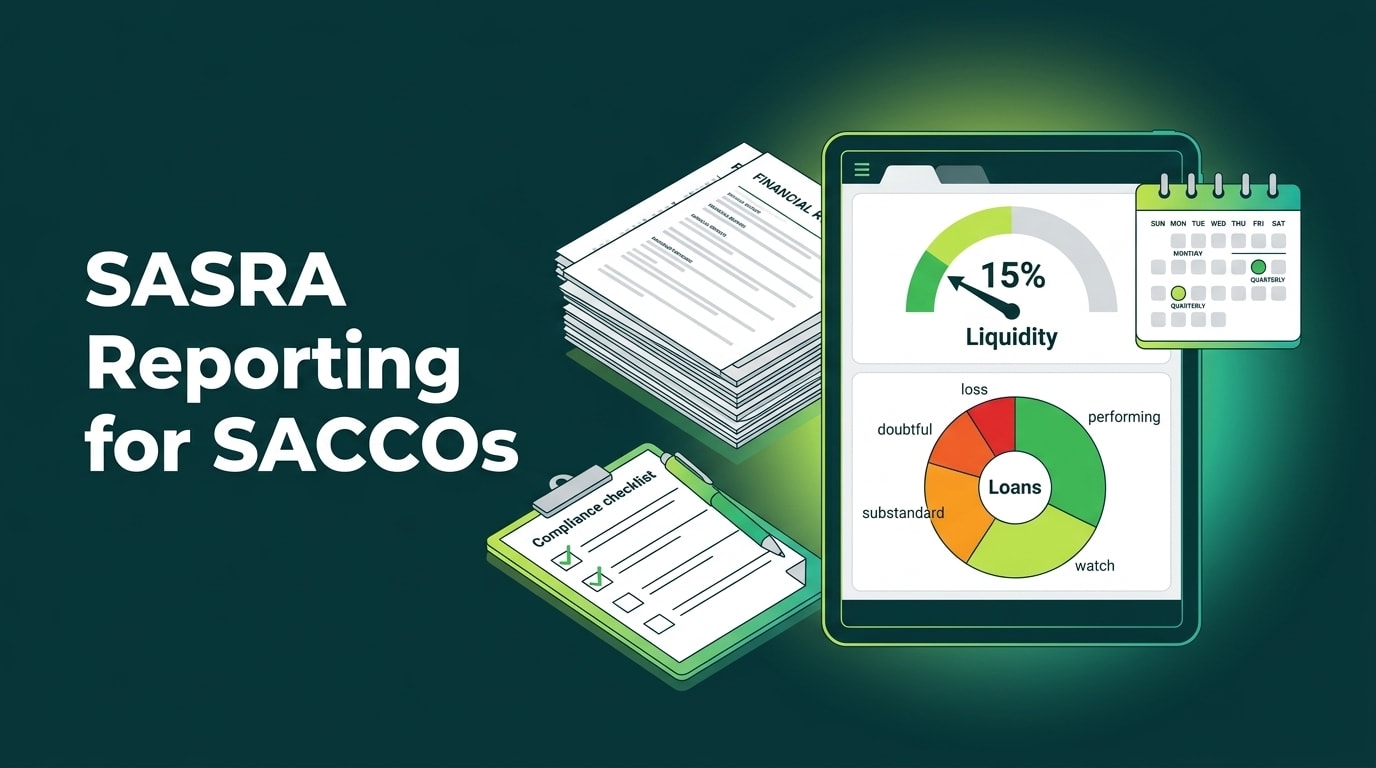
If your SACCO is regulated by the Sacco Societies Regulatory Authority (SASRA), reporting isn't once a year. Some returns are due every month, some every quarter, and the audited accounts once a year. Each return depends on accurate data, and the loan book is where most of the hard numbers come from.
This guide summarises what SASRA requires deposit-taking SACCOs to report and when. It covers the capital and liquidity ratios you must maintain, how loans must be classified and provisioned, and what your systems need to produce. The figures come from the Sacco Societies (Deposit-taking Sacco Business) Regulations, 2010, as published on Kenya Law. SASRA can issue further guidelines, so always check sasra.go.ke for the current forms.
Which SACCOs does SASRA regulate?
SASRA licenses and supervises SACCOs that carry on deposit-taking business under the Sacco Societies Act, 2008, and also supervises specified non-withdrawable deposit-taking SACCOs. Smaller SACCOs that don't take withdrawable deposits fall under the Commissioner for Co-operative Development instead. Licences are issued for one year and must be renewed.
SASRA returns: what is due and when
| Return | What it reports | Frequency | Deadline |
|---|---|---|---|
| Form 1: Capital Adequacy | Core and institutional capital against assets and deposits | Monthly | 15th of the following month |
| Form 2: Liquidity Statement | Liquid assets against savings deposits and short-term liabilities | Monthly | 15th of the following month |
| Form 3: Statement of Deposit Return | Withdrawable and non-withdrawable deposits | Monthly | 15th of the following month |
| Form 4: Risk Classification of Assets and Provisioning | Loans by classification and required provisions | Quarterly | 15th of the month after quarter end |
| Form 5: Investment Return | The SACCO's investments | Quarterly | 15th of the month after quarter end |
| Forms 6–8: financial statements | Statement of financial position, statement of comprehensive income and supporting statements | Monthly, with month, quarter-to-date and year-to-date figures at each quarter end | 15th of the following month |
| Audited financial statements | Full audited accounts, submitted for SASRA's approval | Annually | Within 3 months of the financial year end, before the AGM |
SASRA's website also lists further forms, including insider lending and performance (Form 9), sectoral lending (Form 4B), daily liquidity (Form 2B), complaints monitoring (Forms 11 and 12) and agency returns. Check which ones apply to your SACCO.
The ratios you must maintain
| Requirement | Minimum |
|---|---|
| Core capital | KES 10 million |
| Core capital to total assets | 10% |
| Institutional capital to total assets | 8% |
| Core capital to total deposits | 8% |
| Liquid assets to savings deposits and short-term liabilities | 15% |
| Maximum loan to any one member | 10% of core capital |
Liquid assets include cash, bank balances net of amounts owed to banks, treasury bills and bonds traded in the secondary market, and deposits at other SACCOs maturing within 90 days.
How SACCO loans must be classified and provisioned
This is where your loan management system matters most. Every loan must be placed in one of five categories, based on days past due or the number of installments outstanding, and a minimum provision held against it:
| Category | Days unpaid | Or installments outstanding | Provision |
|---|---|---|---|
| Performing | Current | None | 1% |
| Watch | 1–30 days | 1 | 5% |
| Substandard | 31–180 days | 2–6 | 25% |
| Doubtful | 181–360 days | 7–12 | 50% |
| Loss | More than 360 days | More than 12 | 100% |
Two further rules affect your income figures. Interest on loans classified as substandard, doubtful or loss must be suspended and not treated as income. And accrued interest income from loans may never exceed thirty days' earnings of the entire loan portfolio.
A worked example
A SACCO has a KES 50 million loan book: KES 44 million performing, KES 3 million watch, KES 2 million substandard, KES 0.6 million doubtful and KES 0.4 million loss. Its minimum provision is:
- Performing: 44,000,000 × 1% = KES 440,000
- Watch: 3,000,000 × 5% = KES 150,000
- Substandard: 2,000,000 × 25% = KES 500,000
- Doubtful: 600,000 × 50% = KES 300,000
- Loss: 400,000 × 100% = KES 400,000
The total required allowance is KES 1,790,000. Every shilling of that comes straight off the SACCO's surplus, and therefore off what can be paid as dividends and interest on deposits. Reducing arrears is the fastest way to protect member returns. See how to manage arrears, penalties and grace periods.
Other lending rules worth knowing
- Early repayment: members may repay a loan early, in whole or in part, on any business day without being charged full-term interest.
- Credit policy: your policy must cover loan limits, collateral and guarantor requirements, appraisal of the borrower's ability to repay, insider lending terms and approval limits for each officer and committee.
- Collateral register: keep an up-to-date register of all securities and collateral held against loans.
- No personal benefit: no director, employee or their immediate family may receive anything of value in connection with a loan the SACCO makes.
What SASRA expects from your systems
The regulations require a deposit-taking SACCO to have an information management system that can perform and account for all transactions and produce the minimum reports SASRA requires. At a minimum it must provide an audit trail report, adequate security features, integrated operations, capacity for future expansion, and a real-time, relational database.
In practice, the hardest part of SASRA reporting is usually not filling in the forms. It is having loan data you can trust: every installment's due date and payment status, so each loan lands in the right classification.
How Lendpoint helps with the loan side
To be clear, Lendpoint does not generate SASRA returns for you, and it doesn't run savings, deposits or shares. What it does is keep the loan side accurate, which is the data behind Form 4 and much of your financial statements:
- Overdue installments flagged from day one. M-Pesa repayments are matched to loans automatically, so the days past due and installments outstanding for each loan are always current.
- Early repayment handled correctly. Members can repay early, and products can offer early repayment discounts.
- Guarantors and collateral are recorded against each loan.
- A full audit trail of every approval, disbursement, penalty and rollover, with role-based staff access.
- A general ledger behind every disbursement, repayment, fee and penalty, with exportable accounting reports.
See how Lendpoint works for SACCOs.
Frequently asked questions
What reports does SASRA require from SACCOs?
Deposit-taking SACCOs submit monthly returns on capital adequacy, liquidity, deposits and financial statements, quarterly returns on risk classification of loans and provisioning and on investments, and audited financial statements within three months of the year end. Most returns are due by the 15th of the following month.
What is the SASRA liquidity ratio?
A SACCO must hold liquid assets equal to at least 15% of its savings deposits and short-term liabilities. Liquid assets include cash, bank balances, treasury bills, tradable bonds and deposits at other SACCOs maturing within 90 days.
What are the SASRA capital requirements?
Core capital of at least KES 10 million, core capital of at least 10% of total assets, institutional capital of at least 8% of total assets, and core capital of at least 8% of total deposits.
How does SASRA classify loans?
Into five categories: performing, watch (1–30 days or one installment unpaid), substandard (31–180 days or 2–6 installments), doubtful (181–360 days or 7–12 installments) and loss (over 360 days or more than 12 installments). The minimum provisions are 1%, 5%, 25%, 50% and 100%.
When must SACCO audited accounts be submitted to SASRA?
Within three months after the end of the financial year, for SASRA's approval before publication and presentation to the AGM. The AGM itself must be held within four months of the year end.
How much can a SACCO lend to one member?
The total loans outstanding to any one member must not exceed 10% of the SACCO's core capital.