Flat Rate vs Reducing Balance Interest in Kenya: Explained with KES Examples

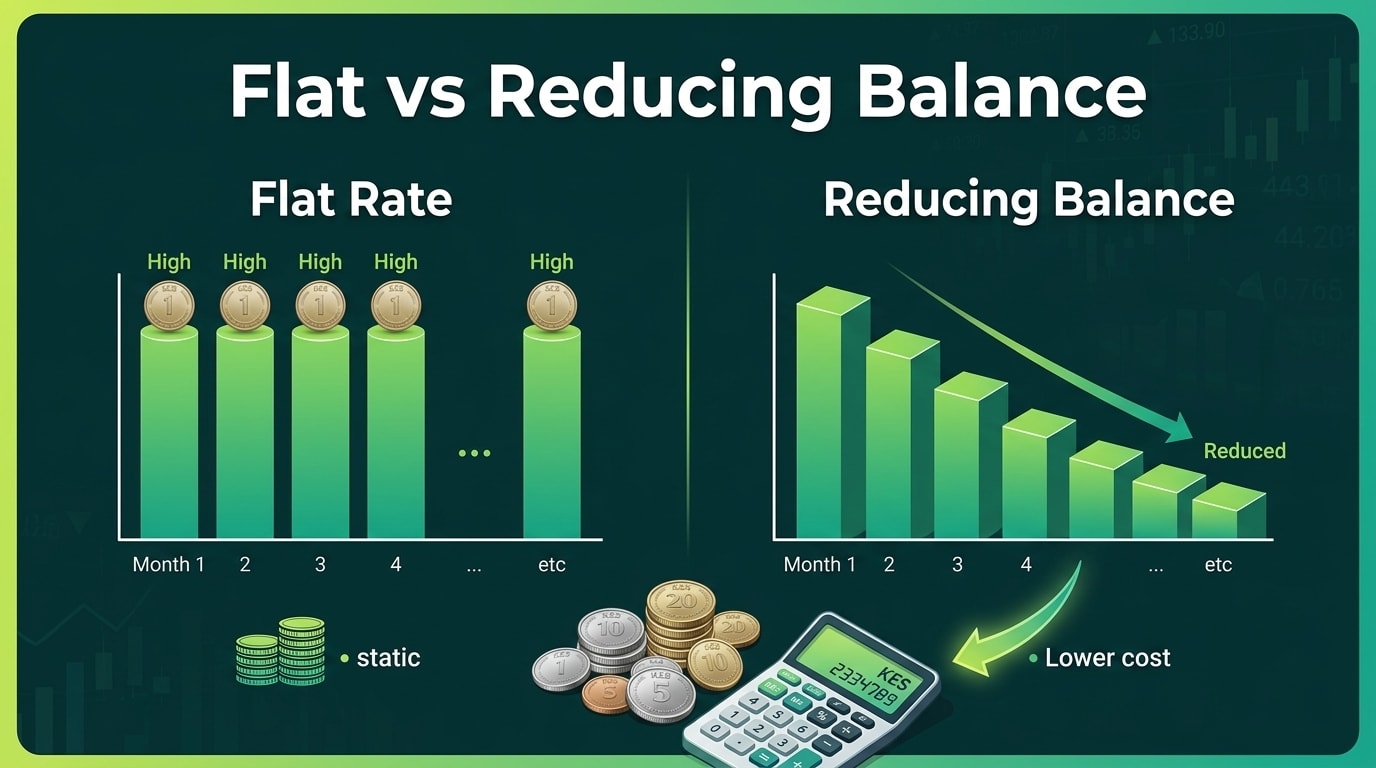
"2% a month" can mean very different loans. On a 12-month loan of KES 100,000, 2% flat costs the borrower KES 24,000 in interest. The same 2% on a reducing balance costs about KES 13,000. That is nearly half, at the same headline rate.
For lenders, the choice between flat and reducing balance interest affects your yield, how competitive your pricing looks and what you must disclose under CBK's rules. For borrowers it determines what a loan really costs. This guide explains both methods with KES examples you can check yourself.
What is flat rate interest?
With flat rate interest, interest is calculated once on the full original principal for the whole term, however much has already been repaid.
Formula: interest = principal × rate per period × number of periods
Example: KES 100,000 at 2% flat per month for 12 months:
- Interest: 100,000 × 2% × 12 = KES 24,000
- Total repayable: KES 124,000
- Monthly installment: KES 10,333.33, the same every month
Flat rate is simple to explain and calculate, which is why it is common in Kenyan microfinance, chama lending and short-term loans. But by the last month the borrower owes only about KES 8,333 of principal, yet is still paying interest as if they owed the full KES 100,000.
What is reducing balance interest?
With reducing balance (also called declining balance) interest, interest for each period is charged only on the principal still outstanding. As the borrower repays, the interest falls.
There are two common ways to structure the installments.
1. Equal principal (declining installments)
The borrower repays the same amount of principal each period, plus interest on the remaining balance, so each installment is smaller than the last. Using the same KES 100,000 at 2% per month for 12 months:
| Month | Balance at start | Principal | Interest (2%) | Installment |
|---|---|---|---|---|
| 1 | KES 100,000.00 | KES 8,333.33 | KES 2,000.00 | KES 10,333.33 |
| 2 | KES 91,666.67 | KES 8,333.33 | KES 1,833.33 | KES 10,166.67 |
| 3 | KES 83,333.33 | KES 8,333.33 | KES 1,666.67 | KES 10,000.00 |
| … | … | … | … | … |
| 12 | KES 8,333.33 | KES 8,333.33 | KES 166.67 | KES 8,500.00 |
Total interest: KES 13,000, against KES 24,000 flat.
2. Equal installments (amortised)
Banks usually fix one installment for the whole term, calculated so that it covers interest on the falling balance and repays the loan exactly. Early installments are mostly interest, and later ones mostly principal.
Formula: installment = P × r ÷ (1 − (1 + r)−n), where P is the principal, r the rate per period and n the number of periods.
For KES 100,000 at 2% per month over 12 months, the installment is KES 9,455.96 and total interest is KES 13,471.52.
Flat vs reducing balance: side by side
| KES 100,000, 2% per month, 12 months | Flat | Reducing (equal principal) | Reducing (equal installments) |
|---|---|---|---|
| Total interest | KES 24,000.00 | KES 13,000.00 | KES 13,471.52 |
| Total repaid | KES 124,000.00 | KES 113,000.00 | KES 113,471.52 |
| First installment | KES 10,333.33 | KES 10,333.33 | KES 9,455.96 |
| Last installment | KES 10,333.33 | KES 8,500.00 | KES 9,455.96 |
| Easy to explain? | Very | Yes | Needs a calculator |
What a flat rate really costs: the effective rate
Because flat interest keeps charging on money already repaid, the true cost is much higher than the headline rate. The flat loan above, with twelve payments of KES 10,333.33 on KES 100,000, is equivalent to a reducing-balance loan at about 3.47% per month. That is roughly 41.7% a year (APR), or 50.7% a year with monthly compounding, compared with 24% a year for 2% reducing.
A useful rule of thumb: for loans repaid in equal installments, the effective rate of a flat loan is a little under double the flat rate.
Short-term micro loans: a weekly example
Many Kenyan micro loans run for four weeks with a single charge for the term. Take KES 10,000 at a 10% charge for 4 weekly installments:
| Week 1 | Week 2 | Week 3 | Week 4 | Total interest | |
|---|---|---|---|---|---|
| Flat 10% | KES 2,750 | KES 2,750 | KES 2,750 | KES 2,750 | KES 1,000 |
| Reducing (10% for the term, 2.5% a week on the balance) | KES 2,750 | KES 2,687.50 | KES 2,625 | KES 2,562.50 | KES 625 |
For a bullet loan repaid in one payment, the two methods give the same interest, because the balance never reduces before the single repayment.
Which method should a lender use?
Flat rate suits:
- very short loans of a few weeks, where the difference is small,
- borrowers who need the simplest possible explanation and a fixed installment,
- products priced as a single fee for the term.
Reducing balance suits:
- longer loans of several months or more, where flat pricing becomes hard to justify,
- competitive markets: a reducing rate lets you quote a fair price without looking expensive next to banks and SACCOs,
- borrowers who may repay early, because interest falls as they pay down.
Whichever you choose, be consistent and transparent. Under CBK's 2026 rules for non-deposit-taking lenders, you must show the borrower the total cost of credit and the APR before they borrow. Your pricing parameters need CBK approval, and so does any change to them. See how CBK licensing and disclosure work.
Avoid calculation mistakes: let your system do the maths
Most interest disputes come from manual calculation: different officers rounding differently, spreadsheet formulas copied wrongly, or schedules recalculated after approval. In Lendpoint, each loan product is set to flat or reducing balance once. The full schedule, including interest, processing and legal fees, is calculated and fixed when the loan is approved. The borrower sees the same numbers as your staff, and repayments through M-Pesa are applied to that schedule automatically. See how loan products work in Lendpoint.
Frequently asked questions
What is the difference between flat rate and reducing balance interest?
Flat rate charges interest on the original loan amount for the whole term. Reducing balance charges interest only on the amount still owed, so interest falls as the loan is repaid. At the same headline rate, a reducing balance loan costs significantly less.
How do I calculate flat rate interest in Kenya?
Multiply the principal by the rate per period and by the number of periods. KES 100,000 at 2% flat per month for 12 months is 100,000 × 0.02 × 12 = KES 24,000 interest, so KES 124,000 is repaid in 12 installments of KES 10,333.33.
How do I calculate reducing balance interest?
For each period, multiply the outstanding balance by the rate per period. With equal principal repayments, KES 100,000 over 12 months at 2% gives interest of KES 2,000 in month one, falling by about KES 166.67 each month, for a total of KES 13,000.
Is 2% flat the same as 2% reducing balance?
No. On a 12-month loan, 2% flat per month is roughly equivalent to 3.47% per month on a reducing balance, about 41.7% a year, nearly double 2% reducing.
Which is better for borrowers, flat or reducing balance?
At the same headline rate, reducing balance is cheaper for borrowers, especially on longer loans or when they repay early. Always compare loans using the total cost of credit or the APR rather than the headline rate.
Do SACCOs use flat or reducing balance interest?
Many Kenyan SACCOs charge interest on a reducing balance for member loans, while flat rates are more common among micro lenders and for short-term products. Check each lender's loan agreement, which must state the method and the total cost.