Lendpoint
The In Duplum Rule in Kenya (2026): How Much Interest Lenders Can Recover on Bad Loans

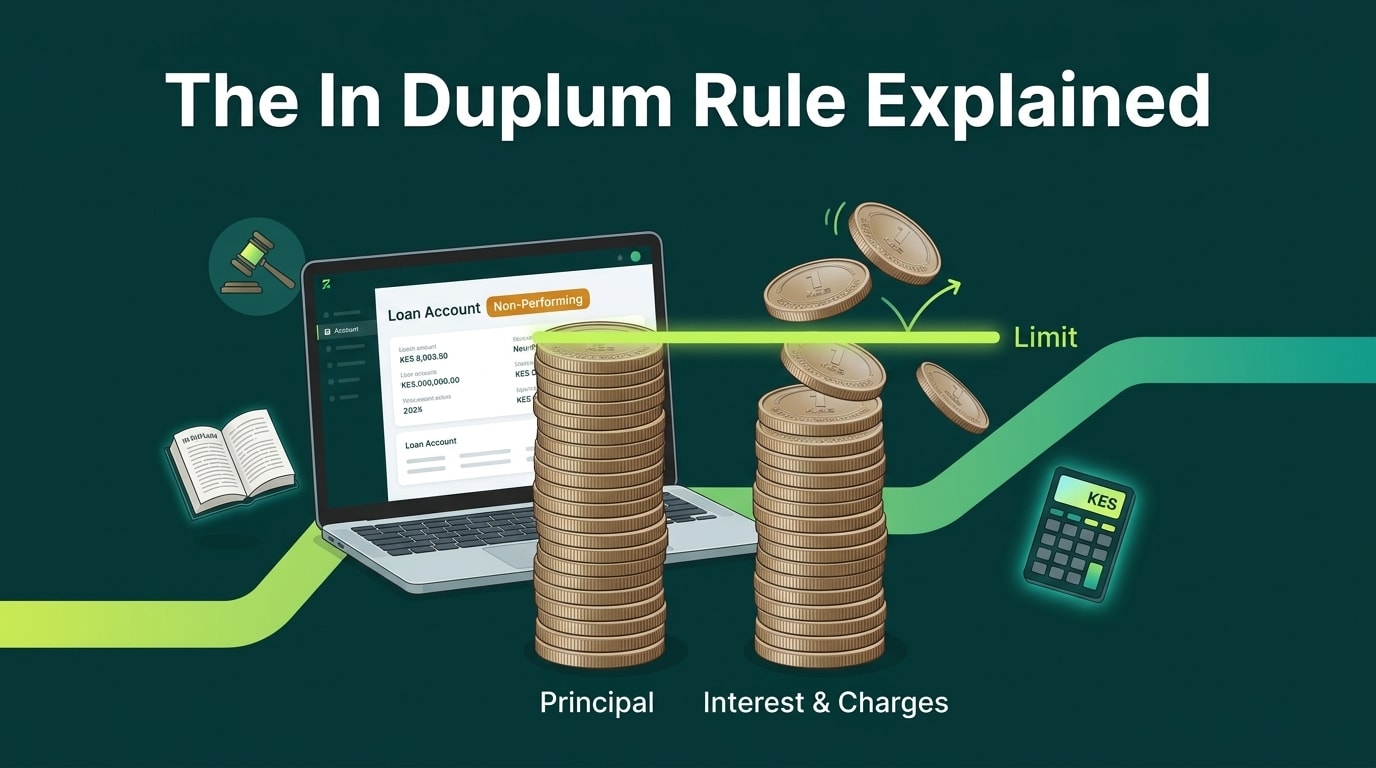
The in duplum rule limits how much interest a lender can recover on a loan that has gone bad. Once a loan is non-performing, the interest recoverable can't exceed the principal owing at that point: interest stops growing once it "doubles" the debt, which is where the Latin name comes from. In Kenya the rule used to be associated mainly with banks. Since 29 September 2026 it also applies, in writing, to every credit-only lender regulated by CBK.
This guide explains which version of the rule applies to which lender, how to calculate the cap with KES examples, how repeated defaults and court cases are treated, and what lenders should do to stay within it.
A practical summary, not legal advice. Check specific loans with your advocate.
Which in duplum rule applies to your institution?
| Lender | Where the rule is | When the cap starts |
|---|---|---|
| Banks | Section 44A of the Banking Act | When the loan becomes non-performing under CBK's prudential guidelines |
| Credit-only lenders: digital and app lenders, micro lenders, logbook and asset lenders, BNPL | Regulation 29 of the CBK (Non-Deposit Taking Credit Providers) Regulations, 2026 (Legal Notice 191) | When the loan becomes non-performing under regulation 57: 30 days unpaid for loans of 30 days or less, otherwise 90 days, or as the loan agreement specifies |
| Deposit-taking SACCOs | The Sacco Societies (Deposit-taking Sacco Business) Regulations, 2010, which cap recoverable interest on a delinquent loan at the principal outstanding when it became delinquent (regulation 31, as summarised in regulatory reviews) | When the loan becomes delinquent: any principal or interest unpaid after its due date |
Before the 2026 regulations, Kenyan courts held that section 44A covered only institutions under the Banking Act. Non-bank lenders sometimes argued it didn't apply to them. For credit-only lenders that argument is now closed: regulation 29 applies the same structure directly. Microfinance banks are licensed under the Microfinance Act, so check their position with your advocate.
How the cap works
Section 44A and regulation 29 use the same formula. On a non-performing loan, the most a lender can recover is:
- the principal owing when the loan became non-performing,
- plus interest under the contract, no more than that principal,
- plus reasonable recovery expenses.
Regulation 29 adds two points for credit-only lenders:
- No interest above the outstanding principal may be recovered at all, except interest under a court order that accrues after the order is made.
- Interest you can't recover directly can't be recovered through the courts either.
Example 1: a simple default
A borrower owes KES 50,000 of principal when their loan becomes non-performing. The contract charges interest that keeps accruing on the unpaid balance.
| Amount | |
|---|---|
| Principal owing at the non-performing date | KES 50,000 |
| Maximum interest recoverable | KES 50,000 |
| Plus reasonable recovery expenses | As actually incurred |
| Maximum recoverable before costs | KES 100,000 |
Suppose interest accrues at KES 5,000 a month. It hits the KES 50,000 cap after 10 months. Anything charged after that can't be recovered, so your system should stop adding it, or you risk collecting money CBK can order you to refund.
Example 2: the borrower resumes paying, then defaults again
The loan above goes non-performing with KES 50,000 owing. The borrower then pays down the principal to KES 30,000 and the loan becomes current, but later becomes non-performing again. The cap is now measured from the latest non-performing date: principal of KES 30,000, plus up to KES 30,000 of interest, plus reasonable expenses. Both section 44A and regulation 29 say the limit is measured from when the loan last became non-performing.
Common questions lenders get wrong
- Penalties and default charges. Default interest and late penalties are often treated as interest for this purpose. Unless your advocate advises otherwise, count them towards the cap.
- Undisclosed charges. Under CBK's 2026 rules, charges not disclosed in the signed contract can't be recovered at all, whatever the cap.
- Guarantors. Under section 44A, "debtor" includes someone liable as a guarantor, so the cap protects guarantors too.
- Court judgments. Interest a court orders, accruing after the order, is outside the cap. Interest that was already beyond the cap before you sued doesn't become recoverable by going to court.
- Refunds. CBK can direct a credit-only lender to refund money recovered above the amount due, so over-collection is a regulatory risk as well as a legal one.
How to stay within the in duplum rule
- Record the non-performing date for every loan, using the definition that applies to your institution.
- Record the principal owing on that date. It sets the cap.
- Stop interest and penalties at the cap. Configure recurring penalties with a maximum number of charges or a ceiling.
- Reset the cap correctly when a loan returns to performing and later defaults again.
- Show the breakdown on statements: principal, interest and charges separately, so borrowers and guarantors can see the cap was respected.
- Brief collectors and advocates. Demand letters and court claims should never include interest above the cap.
For the full set of collection rules, see debt collection rules for lenders in Kenya. For bad-loan definitions and portfolio measures, see how Kenyan MFIs cut NPLs.
Configuring penalties in Lendpoint
- The default penalty is a single one-off charge on each overdue installment.
- Products can instead use custom penalty rules that repeat daily, weekly or monthly. Each rule can have a maximum number of charges and a cap as a percentage of the loan, so you can set rules that stay within the limit that applies to you.
- Penalties can be waived per loan.
- Every penalty is written to the loan's audit log.
- Borrowers can see their loans and statements in the portal and app.
Choosing a system? Read our complete guide to the loan management system in Kenya.
Frequently asked questions
What is the in duplum rule in Kenya?
It caps what a lender can recover on a non-performing loan at the principal owing when the loan became non-performing, plus interest no greater than that principal, plus reasonable recovery expenses. For banks it is in section 44A of the Banking Act, and for credit-only lenders in regulation 29 of CBK's 2026 Non-Deposit Taking Credit Providers Regulations.
Does the in duplum rule apply to digital lenders and loan apps?
Yes. Since the CBK (Non-Deposit Taking Credit Providers) Regulations, 2026 took effect on 29 September 2026, regulation 29 applies the in duplum cap to non-deposit-taking credit providers, including digital lenders, micro lenders and logbook lenders.
Does the in duplum rule apply to SACCOs?
For deposit-taking SACCOs, the Sacco Societies (Deposit-taking Sacco Business) Regulations, 2010 cap the interest recoverable on a delinquent loan at the principal outstanding when it became delinquent. Check the regulation's current text and SASRA guidance for your SACCO.
When does the in duplum cap start?
When the loan becomes non-performing. For credit-only lenders that is 30 days unpaid for loans of 30 days or less, and 90 days for longer loans, unless the agreement specifies otherwise. If the loan recovers and defaults again, the cap is measured from the latest non-performing date.
Can a lender get around in duplum by going to court?
No. Interest that couldn't be recovered under the cap can't be recovered through a judicial process. Only interest under a court order that accrues after the order is made falls outside the cap.
Do penalties count towards the in duplum cap?
Default interest and late penalties are commonly treated as interest for this purpose, so the safe course is to count them. Charges not disclosed in the signed contract can't be recovered at all.